Biography
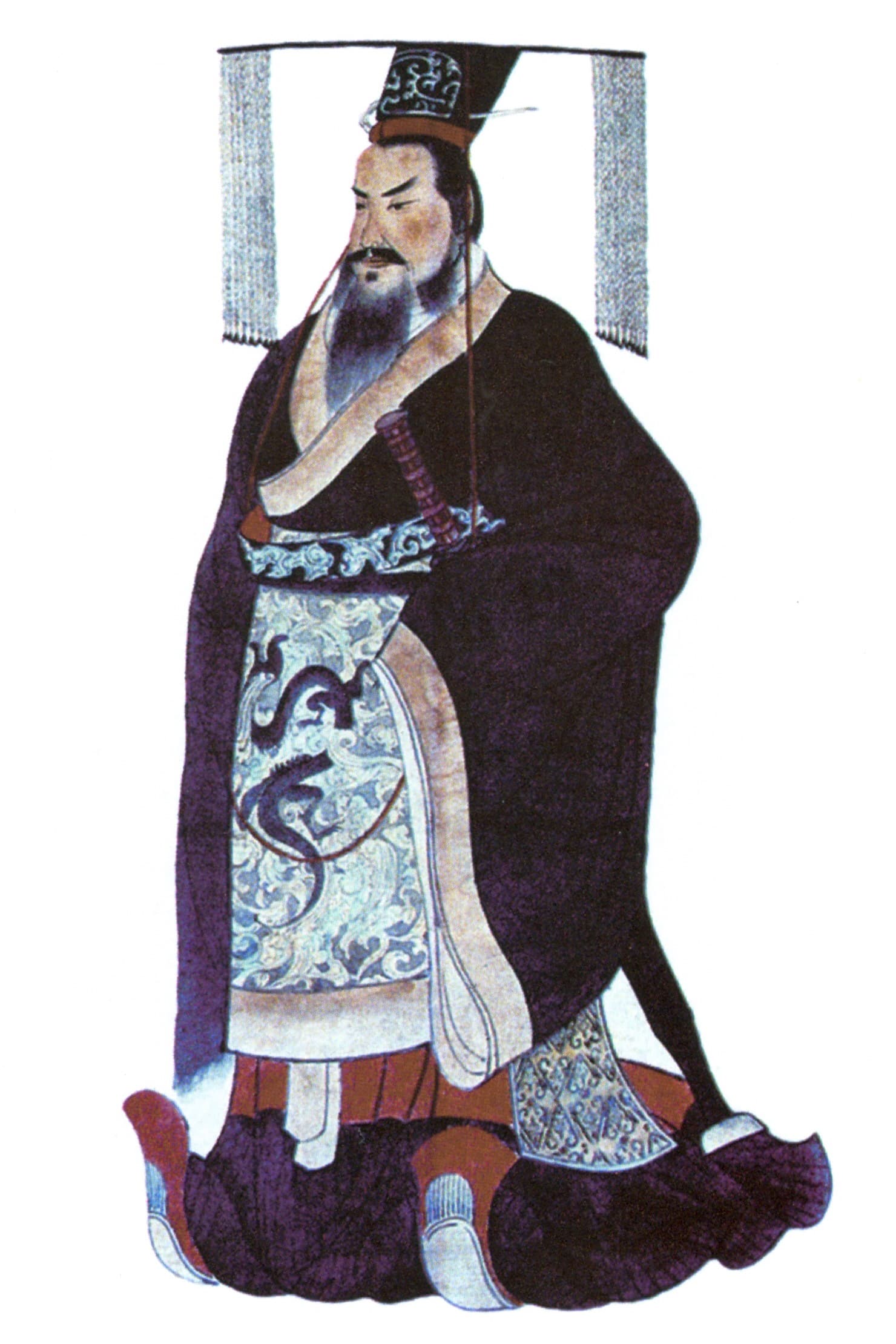
Qin Shi Huang (Ying Zheng, 259–210 BC) was the founder of the Qin dynasty and the first emperor to unite China. Born in Handan, Zhao, as the son of a Qin prince and a concubine, he ascended the throne of Qin at age 13. Over the next two decades, he skillfully navigated court politics and military campaigns to achieve what no ruler before him had accomplished.
Between 230 and 221 BC, King Zheng of Qin conquered the six rival states—Han, Zhao, Wei, Chu, Yan, and Qi—ending centuries of warfare during the Warring States period. He proclaimed himself 'Shi Huangdi' (First Emperor), believing his dynasty would endure for ten thousand generations.
To consolidate his vast empire, Qin Shi Huang implemented sweeping reforms: he abolished feudalism and divided the realm into 36 commanderies under central control, standardized Chinese script (small seal script), weights and measures, and axle lengths. He built an extensive road network and connected existing defensive walls into what would later become the Great Wall of China.
His regime was also notorious for its harshness. He burned philosophical texts and buried 460 scholars alive, an act known as the 'Burning of Books and Burying of Scholars.' He conscripted hundreds of thousands of laborers to build his magnificent Epang Palace and his colossal mausoleum guarded by the Terracotta Army.
Seeking immortality, Qin Shi Huang sent expeditions to find the elixir of life. He died during an inspection tour in 210 BC, and his dynasty collapsed within three years due to widespread rebellion. Despite its brevity, the Qin dynasty established the administrative blueprint—centralized bureaucracy, standardized writing, and unified measurements—that would define Chinese civilization for the next two millennia.
"I am the First Emperor. Future generations shall count themselves: Second, Third, and so on unto ten thousand generations, passing down endlessly."
—— 《史记·秦始皇本纪》