波希多尼
Posidonius
Posidonius
Biography
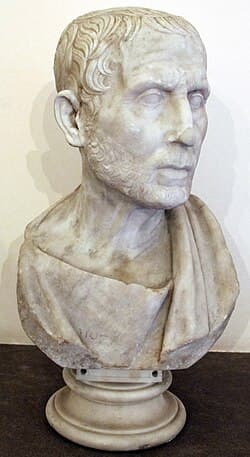
Posidonius (/ˌpɒsɪˈdoʊniəs/; Ancient Greek: Ποσειδώνιος Poseidṓnios, "of Poseidon") "of Apameia" (ὁ Ἀπαμεύς) or "of Rhodes" (ὁ Ῥόδιος) (c. 135 – c. 51 BC), was a Greek politician, astronomer, astrologer, geographer, historian, mathematician, and teacher native to Apamea, Syria. He was considered the most learned man of his time and, possibly, of the entire Stoic school.
After a period learning Stoic philosophy from Panaetius in Athens, he spent many years in travel and scientific researches in Spain, Africa, Italy, Gaul, Liguria, Sicily, and on the eastern shores of the Adriatic. He settled as a teacher at Rhodes, where his fame attracted numerous scholars.
Next to Panaetius he did most, by writings and personal lectures, to spread Stoicism to the Roman world, and he became well known to many leading men, including Pompey and Cicero.
His works are now lost, but they proved a mine of information to later writers. The titles and subjects of more than twenty of them are known. In common with other Stoics of the middle period, he displayed syncretic tendencies, following not just the earlier Stoics, but making use of the works of Plato and Aristotle.
A polymath as well as a philosopher, he took genuine interest in natural science, geography, natural history, mathematics, and astronomy. He sought to determine the distance and magnitude of the Sun, to calculate the diameter of the Earth, and to determine the influence of the Moon on the tides.
"Nature itself is God, containing all that exists."
—— Fragments